
Juan Atkins for Dekmantel Festival x Patta Magazine
Words by Hannah Pezzack | Photography by Dana Lixenberg and Laura van der Spek | In partnership with Patta

Founder of Metroplex Records and the force behind pioneering projects including Cybotron (with Rik Davis, amongst others) and Model 500, he is widely regarded as the godfather of techno. He literally gave the genre its name, adopting the term in the 1980s to describe his funky, future-facing fusion of man and machine.
Far from the kickdrum-heavy variants we might be used to in Western Europe – the repetitive doof, doof, doof – the Detroit brand is elastic and intricately melodic, full of gleaming, gliding synths and squelching basslines. At times, it becomes almost orchestral, as is the case with Infiniti – the 1990s project Atkins refers to as “pure techno” – with rippling rhythms, pattering bleeps and bloops, and a near-cinematic sense of scale. It’s music that feels less tethered to the dancefloor than suspended somewhere above it, conjuring an intergalactic atmosphere echoed in track titles such as “Martians At Work”.
It was this vision — and, in particular, a fascination with science fiction — that I wanted to hone in on when we sat down at De Balie in Amsterdam as part of the Dekmantel conference. Juan Atkins was in town for two performances during the festival: a DJ set on the RADAR stage in the Amsterdamse Bos, streamed live, and a show at Melkweg under the Infiniti alias, marking 30 years since the release of the album The Infiniti Collection on Tresor.
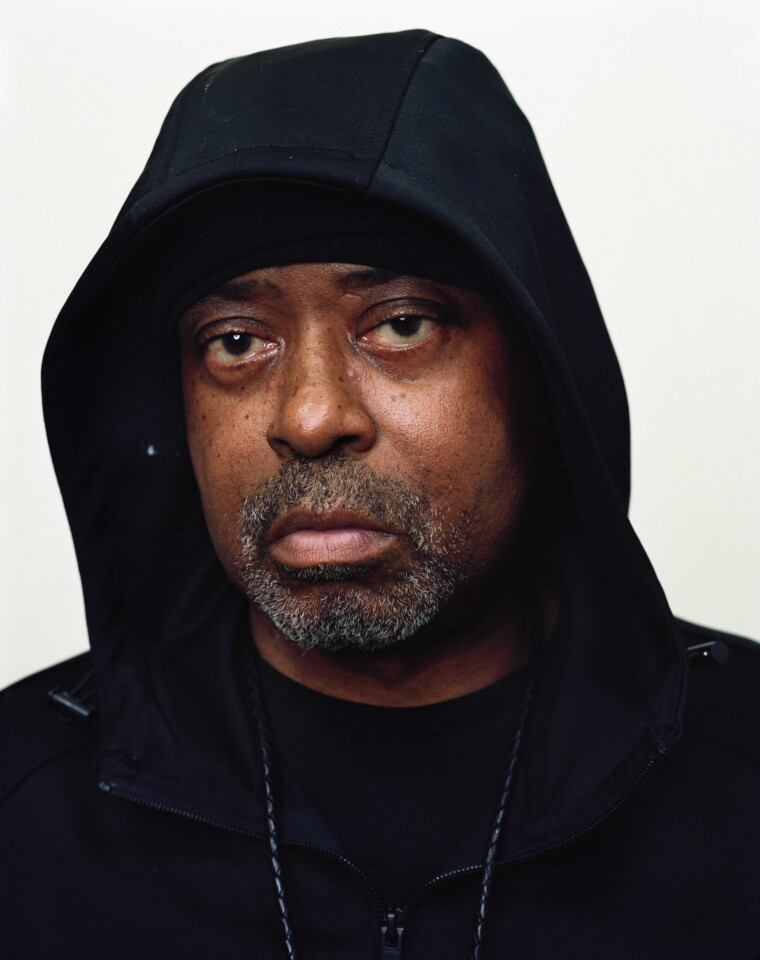
Arriving at the venue dressed entirely in black – hood pulled up, dark sunglasses, and patent boots – Atkins cuts a striking figure. There has always been a consciously space-age finesse to his look, not least in the geometric, oversized shades that have become something of a signature. But this futurism runs deeper than aesthetics: it speaks to a philosophy that has underpinned techno since its inception, rooted in an enduring fascination with technology and the possibilities of worlds not yet realised.

"It’s music that feels less tethered to the dancefloor than suspended somewhere above it."
Juan Atkins was born in Detroit, Michigan, a city whose identity is itself bound up with mechanisation. Detroit had been synonymous with innovation, the headquarters of America’s “Big Three” carmakers: General Motors, Ford and Chrysler. Vast factories dominated the urban landscape and employed huge swathes of the population. But by the 1950s and ’60s, cracks were beginning to appear. Automation was transforming the factory floor, and manufacturers had begun shifting production overseas, leading to widespread domestic job losses.
The effects were felt especially acutely by Black working-class communities, who had never shared equally in the wealth generated by the industrial boom. Decades of racial segregation and discriminatory housing practices had restricted where Black citizens could live, while tensions over inequality and aggressive policing culminated in the 12th Street uprising of 1967, one of the deadliest episodes of civil unrest in US history. In its aftermath, many white residents left for the suburbs, leaving behind an increasingly impoverished, majority Black inner city.
By the 1970s, however, that demographic transformation was reshaping political and cultural institutions, as Black Detroiters claimed spaces from which they had historically been excluded. Among them was WGPR – Where God’s Presence Radiates – Michigan’s first Black-owned FM radio station. Indeed, when I ask what he remembers of this period – his childhood in the 1960s and ’70s – Atkins turns not to the upheavals that defined the era, but to its soundtrack. As a teenager, he became an obsessive listener to WGPR and, in particular, the broadcasts of one enigmatic DJ: The Electrifying Mojo.
Mojo was unlike anything else on the airwaves at the time. Speaking over spaceship sound effects, his freeform broadcasts traced a line between funk, jazz, soul, R&B and the icy, angular synths of European groups like Kraftwerk. A seismic figure, he is described by DeForrest Brown Jr. in the 2022 book Assembling a Black Counterculture as “an innovator in the Black community and radio broadcasting, beaming in sounds from distant lands that expanded the imaginations of anyone his signals reached.” “We would listen to him religiously,” says Atkins. “Without Mojo, none of this [Detroit techno] would exist.”
Although the term “Afrofuturism” would not be coined until the 1990s, its impulses reverberated through Mojo’s eclectic selections. Nowhere more so than in the mythology of George Clinton’s Parliament-Funkadelic, where the heavy, bouncing bass of Bootsy Collins accompanied Clinton’s spiralling narratives, and outer space became a realm of possibility: somewhere the constraints of earthly existence could be gleefully scrambled.
Listening to early Cybotron records — propelled to prominence by Mojo himself, who put their debut 1981 single “Alleys of Your Mind” into heavy rotation — it’s impossible to ignore the funk inheritance. “[Our sound] came from the ghetto, and I think that that’s the difference in what the world terms techno worldwide,” Atkins states. “You can hear it in Detroit music. It's just, you know, a little bit more groovy, a little bit more funky.” In Cybotron’s rubber-band basslines, that lineage is audible; in their spoken-word lyrics, they evoke “laser beams” that “cloud your dreams”, cosmic cars and techno cities—and, later, under Atkins’ Model 500 alias, UFOs hovering overhead.
This cosmic lexicon was also rooted in Atkins’ interest in theory and literature. At De Balie, we touch on one of his favourite novels – “one of the first sci-fi books I ever got into” – Arthur C. Clarke’s Childhood’s End. Published in 1953, it imagines aliens arriving on Earth not as conquerors but as benevolent custodians, bringing an end to war, racism, and animal cruelty, and ushering humanity into an age of computerised abundance. While in high school, as part of a class called Future Studies, Atkins was exposed to the American futurist Alvin Toffler, author of Future Shock and The Third Wave. In these books, technological advancement is depicted as a seismic force capable of radically reorganising society. Toffler’s influence was profound: the term “techno” and the name of Atkins’ label, Metroplex, were drawn from his vocabulary.
Against the backdrop of 1980s Detroit, such hopeful visions of the future carried a particular charge. There is a potent scene in Universal Techno, a 1996 documentary produced for the French-German broadcaster ARTE, in which Atkins reflects on his hometown’s transformation. It was, he says, “the first North American city to experience the technological revolution”: a place where robots were making human workers obsolete. As he speaks, the camera pans past dilapidated houses and abandoned buildings – the urban scars left in the wake of that shift.
Yet the music that emerged from these conditions did not simply reproduce their bleakness. Drawing on the anticipatory imagery of writers like Clarke and Toffler, Atkins’ work seemed instead to dream beyond what DeForrest Brown Jr. calls the “structural failings of a post-industrial collapse”, towards something not yet realised; a better world to come. “I’ve always been a fan of the future. It was kinda rough in Detroit, so thinking about the future became a great escape […] I am an optimist. My way of looking at it was that a person working in the factory may have lost their job, but maybe then they should learn something about technology.”
“[Our sound] came from the ghetto, and I think that that’s the difference in what the world terms techno worldwide,” Atkins states. “You can hear it in Detroit music. It's just, you know, a little bit more groovy, a little bit more funky.”
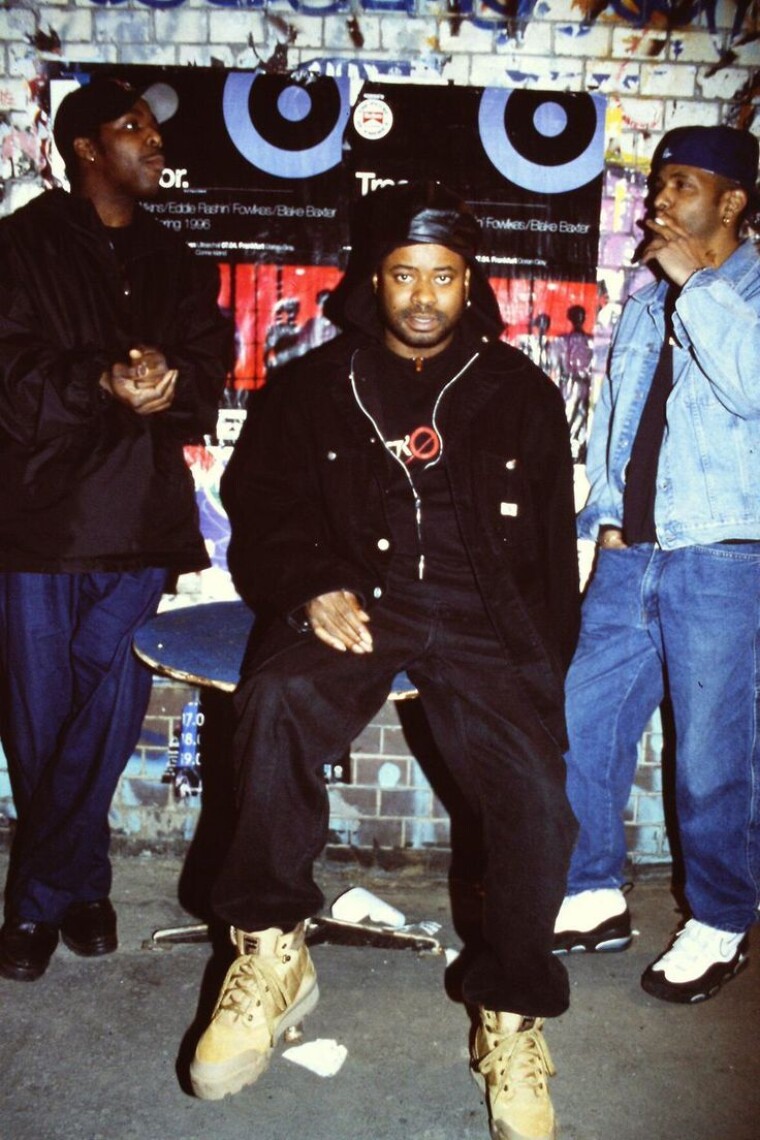
If Detroit had been at the forefront of the technological age, by the 1990s the upheavals of the post-industrial era were being felt across parts of Europe too. Berlin, in particular, seemed to exist, as Atkins puts it, “in symbiosis with Detroit”. The circumstances were very different, but the two cities shared a similarly fractured landscape: full of empty warehouses, and young people building a new culture amid the remnants of the old. In Michigan, those spaces were the legacy of deindustrialisation and population loss; in Berlin, they had been opened up by the fall of the Wall and reunification. Techno found a natural home in both, and the connection soon became tangible, with people, ideas and equipment moving back and forth across the Atlantic. “Mark Ernestus, Thomas [Feldman] and Moritz von Oswald would come to Detroit and buy up synths from the pawn shops,” Atkins remembers. “They’d take them back to Germany and retrofit them with MIDI.”
For all the grand lineages and global legacies of Detroit techno, however, perhaps the most touching story is also the most intimate. When I ask Atkins about his family, he fondly recalls his grandmother, Lily – “God rest her soul” – and playing her Hammond B-3, a 1950s electronic organ whose distinctive sound became a fixture of jazz, gospel, and R&B. Long before he ever laid hands on a sequencer or drum machine, the Hammond was Atkins’ first electronic instrument. It was Lily, too, who took him a step further, buying him his first synthesizer: a Korg MS-10.
Although techno might have sounded like a rupture with everything that preceded it – synthetic, machine-made, and seemingly without precedent – these early encounters suggest something closer to a continuum; an extension of Black musical traditions, encouraged along the way by a grandmother with an instinct for where her grandson’s curiosity might lead. More than four decades later, that curiosity shows little sign of abating. When I ask Atkins whether he has any plans to retire or slow down, his answer returns us, fittingly, to the outer-space imagery with which we began: “I’m going to be making music ’til I leave this planet, and then maybe for some time afterwards too.”
“I’m going to be making music ’til I leave this planet, and then maybe for some time afterwards too.”

Patta Magazine Volume 7 is available now at Patta chapter stores in Amsterdam, London and Milan.