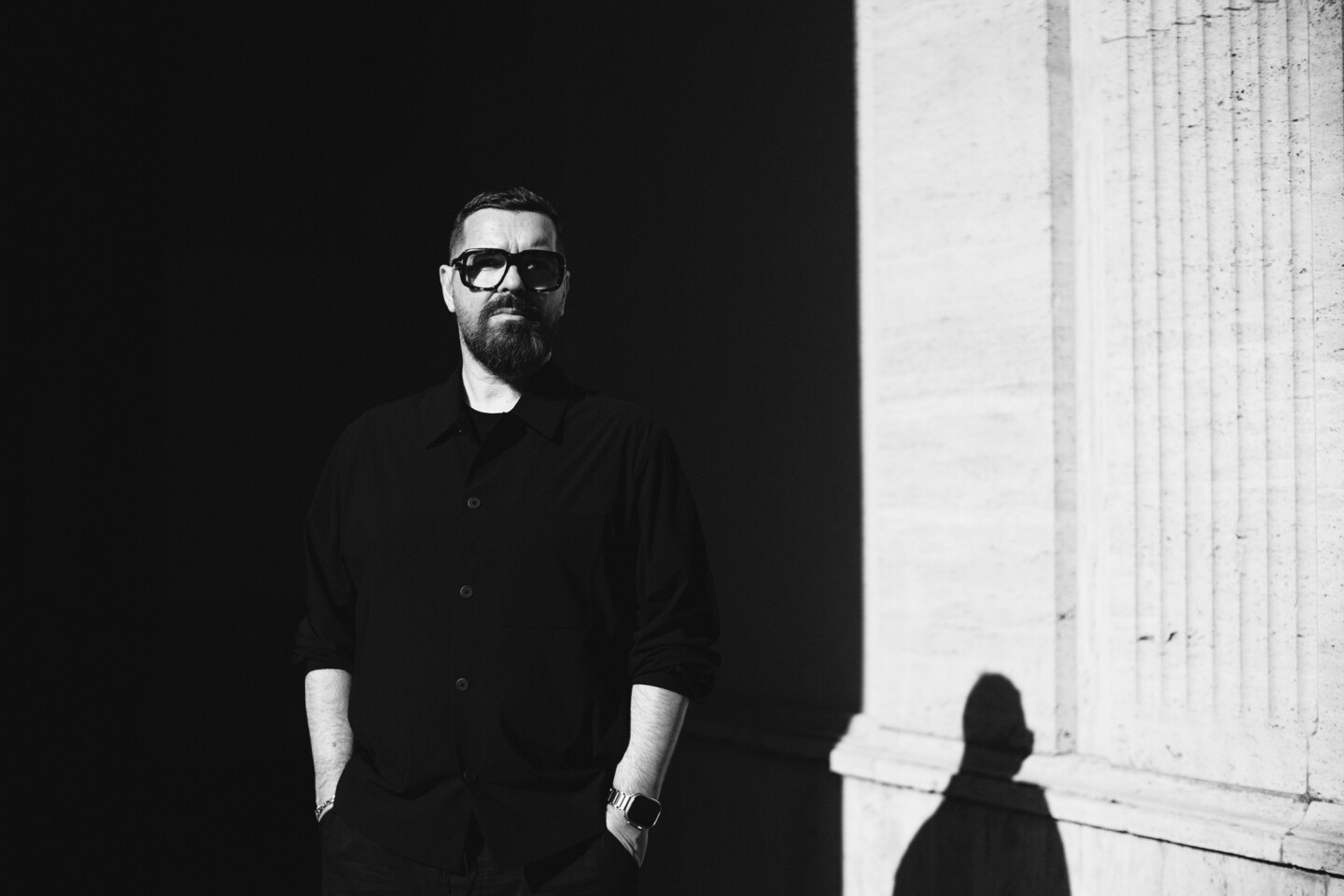
This year marks the first collaboration between Dekmantel and STOOR: on Thursday 30 July, the boundary-pushing improvisational platform returns to Paradiso for a special co-curated programme. In the lead-up to this exciting venture—as well as his DJ set on the UFO stage in the Amsterdamse Bos on Friday 31 July—we sat down for a chat with STOOR founder Speedy J.
On paper, STOOR is a simple concept: musicians coming together to improvise live. In practice, however, the project is redefining the paradigms of electronic performance, shifting the producer away from a solitary auteur and towards a collaborative ecosystem.
Founded by Speedy J (aka Jochem Paap), STOOR started out—and continues to exist—as a subterranean studio in the heart of Rotterdam, equipped with an extensive collection of drum machines, synthesizers, and signal-processing gear. When the COVID-19 pandemic brought everyday life to a standstill, Paap and his team quickly adapted the operation into a streaming platform for remote jam sessions, enabling a rotating cast of global techno innovators to connect and create spontaneously online.
At a moment when dancefloor unity felt impossibly distant, STOOR offered a new form of collective experience—one that has endured long after clubs reopened. What began as an emergency solution has since evolved into a record label, media outlet, and series of shows centred on a radical premise: invited artists arrive with zero prepared material. Rather than relying on pre-recorded stems or fixed arrangements, the participants build each set from the ground up, responding intuitively to one another and allowing the music to emerge in real time.
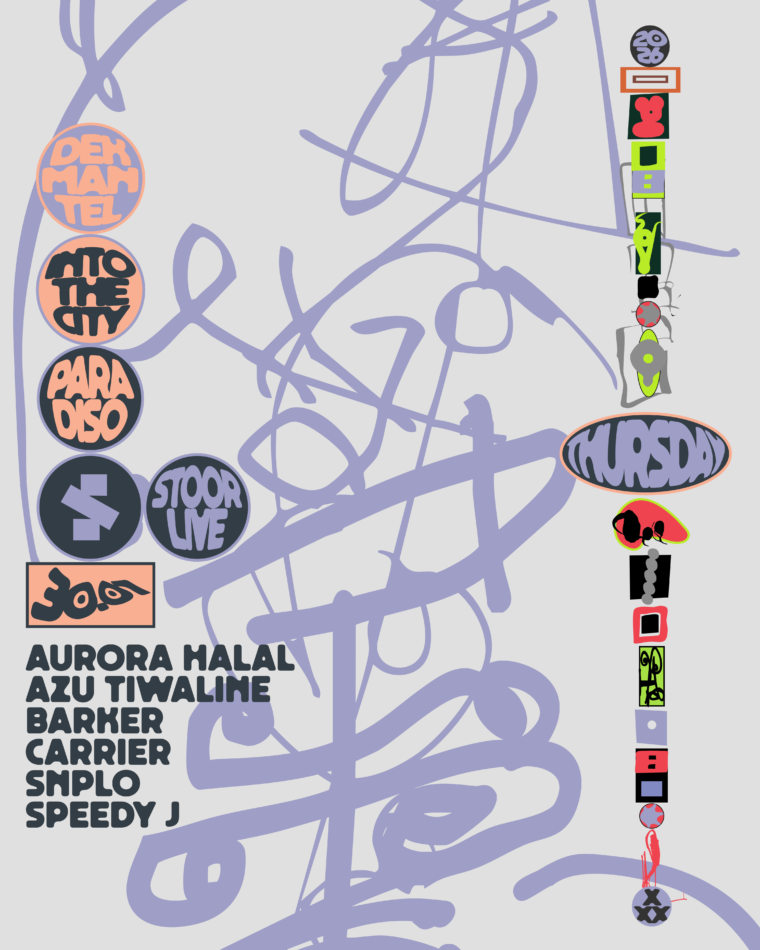
At the Dekmantel x STOOR event, Speedy J will be joined in Paradiso's Main Hall by Aurora Halal, Azu Tiwaline, Barker and Carrier for an expansive, seven-hour sonic dialogue. Framed by robotic cameras, immersive lighting, intricate stage design and an entourage of video artists, the concert promises to be as visually absorbing as it is sonically unpredictable. Meanwhile, upstairs in the Bovenzaal, SnPLO (SnP 500 and PLO Man) present their trance-inducing, loop-based hardware set, drawing listeners into a hypnotic world of subtle variation and repetition.
Ahead of this ambitious meeting of minds, we spoke to Speedy J about his ideals, vision, and the elusive flow state that emerges when individual control gives way to shared intuition—those exhilarating moments when harmony is found and time itself seems to stand still.
STOOR seems to be a project guided as much by artistic exploration as it is by ethics. Within it, I recognise a core value: collaboration, and all that entails. Can you expand on this?
My philosophy is that everyone involved—both on stage and behind the scenes—is an essential contributor. From the staff working the bar to the toilet attendant, every person plays a crucial role in making the night a good experience.
One of the ways this philosophy manifests is how we work with artists. Regardless of profile or reputation, they all receive the same fee. Every artist on stage is just as vulnerable, just as committed, and invests the same level of effort, so each contribution is valued equally.
When I invite artists to take part, I’m aware that I'm asking a lot. Improvisation pushes you outside your comfort zone. It’s inherently risky and demands a great deal of vulnerability. Creating an environment where everyone feels equal is therefore vital. It’s what binds us together over the course of the marathon-length, seven-hour concert.
Most of the musicians have never performed in this way before, so the entire project depends on trust and openness: the ability to have faith in one another, to create spontaneously, to leave space, accept constraints, and listen deeply. At its core, improvisation is an act of listening rather than an act of doing.
The duration is just as fundamental. Seven hours gives ideas room to emerge and evolve. If we only played for an hour, it would feel crowded and chaotic. Instead, we each slowly find our place, discovering our roles, settling into a rhythm.
In that sense, what the audience encounters is almost a live rehearsal. That's the beauty of it. The crowd watches a group of musicians who begin as strangers gradually develop a shared language and become a band in real time. Rather than presenting a finished product, STOOR invites the audience into a raw, evolving process.
The trust you've described between the musicians extends to the audience as well. We, too, have to trust the process, allowing ourselves to be taken on a journey with no predetermined destination.
That's true. I find that most people who come to STOOR are very open-minded. They aren't necessarily expecting to be blown away from the outset. Instead, they come to witness an unfolding process: to watch a group of musicians gradually feel things out until something clicks. That’s the journey the crowd is invested in—the moment when everything suddenly aligns, and the music takes on a life of its own.
I often say that the artists are as much spectators as they are creators. As a musician, it's an amazing feeling to be aligned with the audience—to have no idea what's coming next; you're experiencing the performance as if you are part of the crowd, even as you're contributing to its direction.
A typical concert, built around material that has been rehearsed and carefully choreographed, doesn't usually involve this level of unpredictability. The same is true of a DJ set: a mix isn't necessarily formulaic, but it still operates within a framework. Both cases offer a relatively safe way of presenting art, and I wanted to push beyond that.
While honouring what you've said about not privileging any one name, I was fascinated by your inclusion of Carrier in the STOOR x Dekmantel line-up. Guy Brewer, who spent more than a decade making music as Shifted, has dramatically reinvented his sound, moving from techno into a much more textural, rhythmically fluid realm. Does that kind of creative flexibility lend itself well to live improvisation?
I've crossed paths with Guy a few times over the years, and I've long been a fan of what he does, especially his recent output as Carrier. It seemed inevitable that he'd eventually join STOOR.
For Dekmantel, I thought he was a particularly good fit because of how he sits alongside the other artists in the line-up, who all inhabit a similar sonic realm—bass-heavy, dubby and spacious. That said—and to answer your question about creative flexibility or malleability—there is never any guarantee of what will emerge. I've noticed that with STOOR, musicians rarely just reproduce their signature sound. More often, they adapt to the constellation of the group, reshaping aspects of their personal style, or even leaving it behind entirely.
That's why it's impossible to predict what will happen. You might have certain expectations based on everyone's individual work, but once we are on stage, the music can take a completely unexpected direction.
While honouring what you've said about not privileging any one name, I was fascinated by your inclusion of Carrier in the STOOR x Dekmantel line-up. Guy Brewer, who spent more than a decade making music as Shifted, has dramatically reinvented his sound, moving from techno into a much more textural, rhythmically fluid realm. Does that kind of creative flexibility lend itself well to live improvisation?
I've crossed paths with Guy a few times over the years, and I've long been a fan of what he does, especially his recent output as Carrier. It seemed inevitable that he'd eventually join STOOR.
For Dekmantel, I thought he was a particularly good fit because of how he sits alongside the other artists in the line-up, who all inhabit a similar sonic realm—bass-heavy, dubby and spacious. That said—and to answer your question about creative flexibility or malleability—there is never any guarantee of what will emerge. I've noticed that with STOOR, musicians rarely just reproduce their signature sound. More often, they adapt to the constellation of the group, reshaping aspects of their personal style, or even leaving it behind entirely.
That's why it's impossible to predict what will happen. You might have certain expectations based on everyone's individual work, but once we are on stage, the music can take a completely unexpected direction.
In an interview for the AIR podcast with Emma Robertson, you stated that you come to STOOR without any stems or pre-recorded material and, apart from discussing equipment and technical riders with the other artists, there isn't any real planning beforehand. Yet you've also said that you don't see this as a lack of preparation. Rather than simply "making it up on the spot", improvisation is the culmination of your career thus far—the result of more than 30 years of musical practice. Could you elaborate on this, and what does STOOR offer you personally?
All artists who improvise draw on their accumulated experience: their fluency with their instruments, their sensitivity to sound, and everything they have learned along the way. These are their tools. Beyond that, improvisation requires a lot of patience and just allowing the music to come into being.
In terms of my own practice, I've always wanted to inject a sense of liveness into studio recordings—to capture the spirit and energy of the moment. I don't like sitting behind a screen, painstakingly drawing notes one by one. I work quickly, and I work in real time.
This approach extends to STOOR as well. Honestly, I trust myself more when I come with absolutely nothing—without any preparation—than when I rehearse a concept beforehand and then try to recreate it live. If I have a predetermined idea, there's always the possibility that it won't work out as intended. But if you arrive with nothing, nothing can really go wrong. Whatever happens simply becomes the performance.
With five artists on stage, ideas begin circulating almost immediately. There is no shortage of creativity or material; the only uncertainty is what might come next—whether someone does something that changes everything and prompts you to respond in a new way.
In this sense, improvisation is a kind of time travel. The past and future fall away; there is only the present moment. You can't dwell on what just happened because it can't be altered, and you don't know what's coming next.
While researching this interview, I came across a Reddit thread speculating about your role. Some posters described you as a kind of conductor who mixes and mutes the other players. Is that an accurate description of what you do?
I'm glad you brought this up. Online there's often a demand for explanations, which I'd actually rather not give, but then inaccurate assumptions start to circulate. To clarify: we're all playing live at the same time. Everybody's signal is always present, and nobody is muting anyone else's sound. It really is a performance by five people, and I'm not interfering. There is no leader.
As musicians, you have to trust one another. You can't be in a band where, say, the singer can suddenly mute the bass player—that would be ridiculous. The whole point is that you're creating something together, and that only works if you trust each other's contributions. If one person could simply cut someone's signal, it would undermine the entire concept. It wouldn't be right, and it wouldn't be fair.
Paradiso is a special venue, not least because it was originally a church. The building has a distinctive acoustic character—the high ceilings and architecture create a sense of resonance that's unlike most concert halls or clubs. Can you speak more about Paradiso, what does it mean to the project?
Paradiso was where the first STOOR Live events took place, so we have a long-standing relationship with that space. The concept was designed around it, with a monolith at the centre and the artists gathered in the middle of the room. The venue's multi-level layout is important because it naturally draws the audience's attention inwards, creating a very different experience from the usual setup, where only those in the front rows have an unobstructed view while everyone else is looking at the backs of heads.
When the crowd faces one another, you notice facial expressions, body language, and the reactions of the people opposite you. It is more intimate; it feels like a gathering rather than a one-way encounter. In that sense, STOOR is actually quite old-school. In the early 1990s, the dancefloor was communal, made up of small circles and groups. Today, audiences tend to face the stage—sometimes even just watching through a phone screen. STOOR seeks to reverse that shift. The project is about reconnection: fostering a connection between the musicians, but also between everyone in the club.
Who is behind the visual identity?
Karl Klomp, whom I've collaborated with for years, is responsible for the stage design and visual direction. He's widely regarded as the grandfather of glitch video art in the Netherlands and developed the distinctive visual language of the fly-on-the-wall studio sessions we streamed during the pandemic. That theatrical aesthetic remains his signature. He also translated those intimate studio sessions into a live environment, conceiving the central video column at the heart of the dancefloor in Paradiso.
Karl and I have very similar responsibilities in STOOR. I curate the musicians for each edition, while he curates the visual artists, giving them a platform that's rarely available in the field. In a concert setting, they are often hired in supporting roles and seldom given equal visibility, but here they're free to experiment and really push their practice, with their names featured prominently on both the event artwork and the line-up. To me, the visual element is just as important as the sound because it profoundly shapes the audience's experience. As musicians, we're responding not only to one another but to the lights and imagery as well—it's an audiovisual jam.
STOOR originated from the specific context of the pandemic and the isolation of lockdown; it filled a gap. Now that it has transitioned to IRL, do you think the project continues to address a deficiency within dance music culture?
Well, I think it does fill a gap, although that was never its mission. Over the years, STOOR has evolved into a platform for artists who want to share their craft. It's not about pretending or performing a role; it's about actually doing.
I believe many makers don't receive the attention they deserve. These days, there's often more emphasis on appearances and going through the motions than on the work itself. Meanwhile, there are people building home studios, experimenting with modular systems, and spending countless hours developing their skills. That group is receiving less recognition and fewer opportunities on international stages.
STOOR isn't intended as a reaction against social media or current trends, but it does occupy a space that runs counter to them. It values the process of making over the performance of making, and I think that's something that's becoming increasingly rare.
Words by Hannah Pezzack